
IC3 Blockchain Camp 2026
June 1-7, 2026 – Princeton University, Princeton, NJ
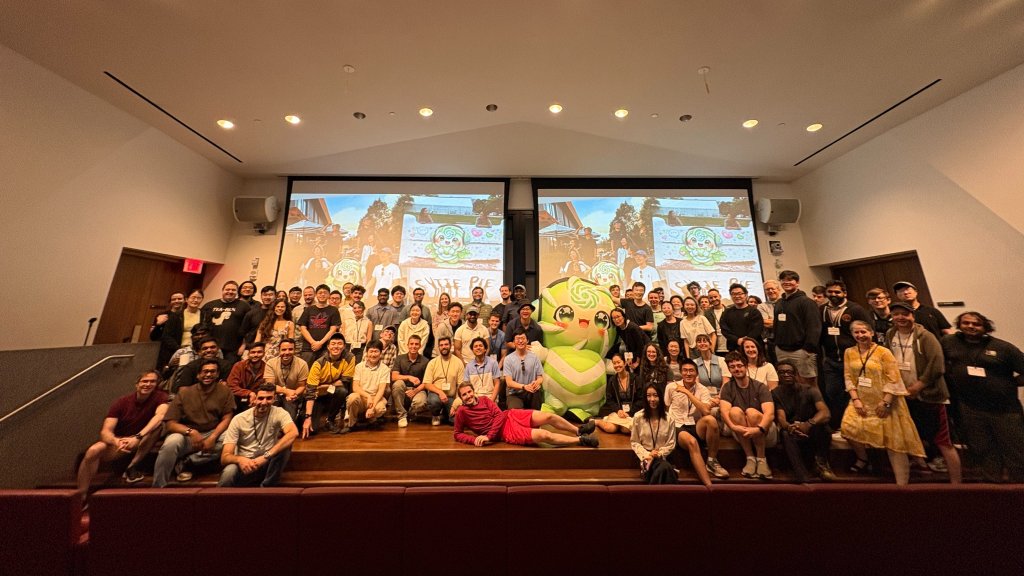
The IC3 Blockchain Camp is one of our biggest events of the year, and the 2026 edition did not disappoint. Over 100 computer scientists, students, and industry researchers attended the Blockchain Camp in Princeton, NJ, for a week of technical talks, networking, and—of course—hacking.
The Agenda
It was a packed agenda featuring presentations from leading academics, scientists, and blockchain researchers.
Hackathon Winners
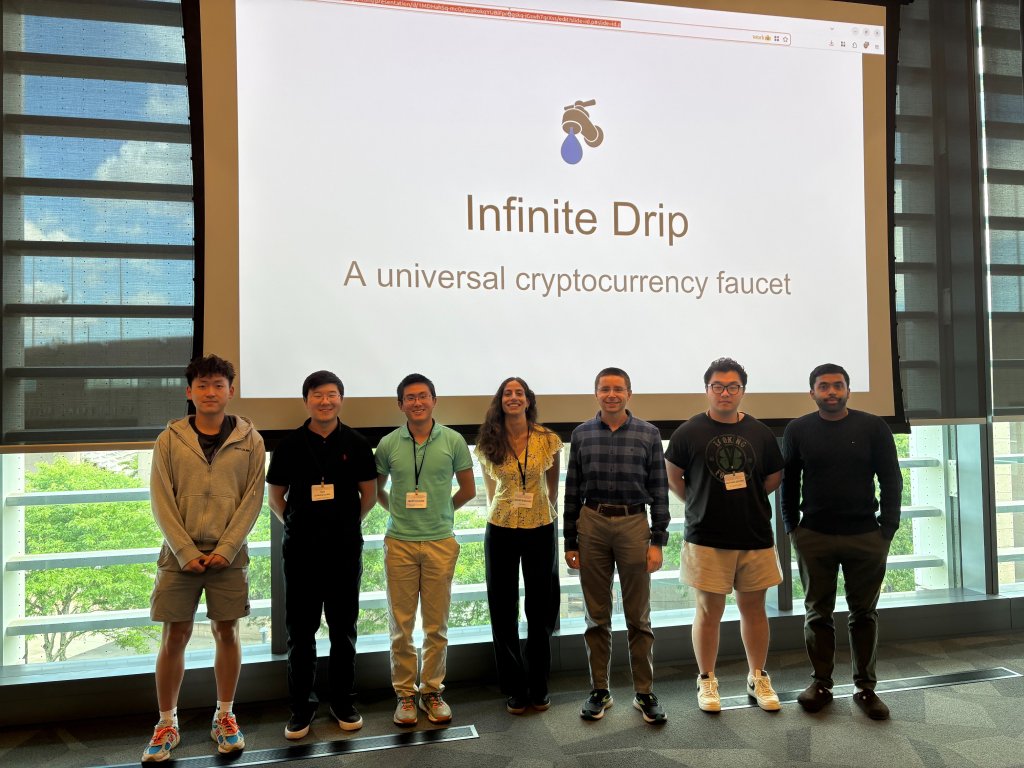
First Place: Infinite Drip
Infinite Drip is a CPU-friendly proof-of-work faucet that anyone (even AI agents) can use to obtain cryptocurrency, with a specific focus on testnet tokens.
Traditional faucets use burdensome anti-Sybil protections—like CAPTCHAs, mainnet balance checks, or social media logins—to rate-limit the distribution of their funds. This is because users provide no value back to the faucet, causing it to eventually run dry.
With Infinite Drip, users participate in proof-of-work to create real value, which is then exchanged for the coins they want, while market forces ensure the supply stays topped up.
Unlike traditional faucets, where an influx of users drains resources or slashes payouts, Infinite Drip scales dynamically. Assuming liquid markets, having more participants actually amortizes the cost of running the faucet, leading to greater efficiency for everyone.
Running autonomously within a TEE, Infinite Drip is entirely self-funding even with a modest number of active users. It automatically exchanges a portion of the user work to cover its own cloud computation costs and stay online.
Thanks to an integration with Crossroads (an IC3 research project), anyone can add new blockchains to the faucet in an entirely permissionless manner, without needing approval from a developer or swap platform.
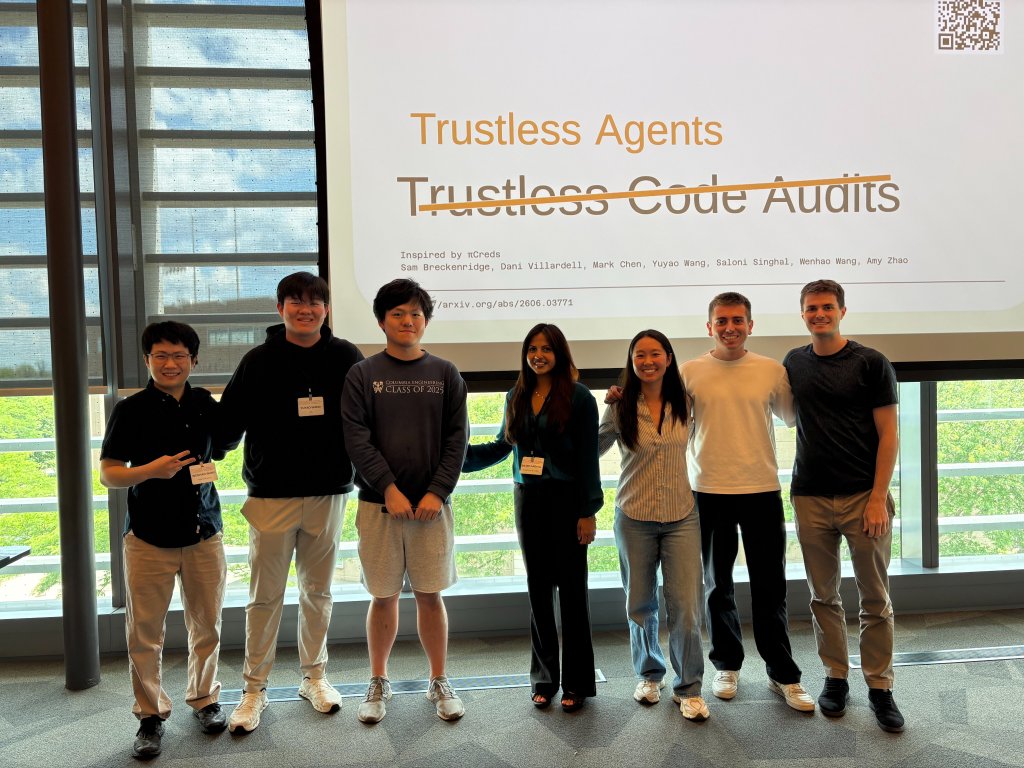
Second Place: Trustless Agents
ERC-8004 proposes a decentralized framework for autonomous agents built on three onchain registries: identity, reputation, and validation. The goal is to shift trust from an agent’s deployer to its actual behavior.
Today, only identity and reputation are active (with 200k+ agents registered), leaving the validation layer entirely missing. This fails to deliver on the promise of a trustless agentic ecosystem, as identity and reputation registries are easily gameable.
Trustless Agents supplies the missing puzzle piece using πCreds, new research from IC3. An LLM auditor runs inside a hardware enclave (Google Confidential Space) to check an agent’s code against its advertised identity entry while scanning for security vulnerabilities.
Crucially, the audit itself is trustless: it executes in an attested TEE, binds to the exact image the agent is running, and emits a signed credential. This Google-backed attestation is verified onchain before being anchored in the validation registry.
The result is a cryptographically grounded, independently verifiable proof of an agent’s behavior, replacing reliance on gameable reputation systems with evidence rooted directly in the code itself.

Third Place: Revamping Governance
The Revamping Governance team set out to rethink how DAOs and decentralized governance operate. Their first step was a deep dive into real-world corporate governance and shareholder voting.
Surprisingly, they discovered that traditional shareholder voting is more private than DAOs, thanks to how brokers aggregate votes. Furthermore, nearly all top US companies fail to facilitate shareholder-to-shareholder communication (i.e., they have no online forums).
With this in mind, the team sought to bring private voting to DAOs without sacrificing their inherent openness.
They implemented a variant of DRE-ip for weighted voting, enabling broker-like vote aggregation while allowing anyone to verify the count by summing the ballots. For communication, they built a Reddit-style forum that leverages governance token weights to signal which prominent members are worth listening to.
Camp Highlights
Fireside with Commissioner Peirce

Getting a jump start on her academic career, SEC Commissioner Hester Peirce joined the IC3 Blockchain Camp to deliver remarks and participate in a fireside chat with Professor Carla Reyes. Here are a few key takeaways from the conversation:
1. The Motivation Behind Dissents: Commissioner Peirce shared that she penned her famous ShapeShift dissent out of frustration after hearing the same conversations. She says it’s not about venting, but the ultimate goal of a dissent is to spark open dialogue on rapidly evolving topics.
2. Breaking Regulatory Silos: Most regulators mean well, and they want to eliminate bad conduct, according to the Commissioner. However, she says without open conversation, rigid top-down methods risk stifling beneficial innovation alongside the bad. Dissents push agencies to step out of their silos and collaborate for better outcomes.
3. Rethinking the “Wild West”: Reflecting on her 2021 Lawless in Austin speech, Commissioner Peirce challenged the narrative that the American frontier was purely lawless. History shows that early communities actually established standards and improved safety organically, simply by helping their neighbors.
4. Organic Regulation: Instead of waiting for government intervention, these communities built order from the bottom up. For Commissioner Peirce, this concept of “organic ground-up regulation” remains a major inspiration for how we should approach and protect modern tech innovation.
Securing Crypto Against Quantum Vulnerabilities

ECDLP is widespread, powering electronic passports, TLS, and MFA. It’s also the cryptographic bedrock of modern blockchain protocols.
At the 2026 IC3 Blockchain Camp, Adam Zalcman from Google Quantum AI outlined a stark future where quantum computers break this foundation. He shared insights from a recent paper he co-authored: Securing Elliptic Curve Cryptocurrencies against Quantum Vulnerabilities.
Blockchains present an incredibly complex risk environment because the threat spans technical, financial, social, and policy vectors, according to Adam. Billions of dollars are currently running on top of a quantum-vulnerable tech stack and mitigating this isn’t easy. Post-Quantum Cryptography (PQC) doesn’t offer simple “drop-in” replacements; it introduces entirely different signature sizes and performance trade-offs that blockchain networks must work around.
Adam explains this isn’t a reason to panic, but rather a call to action. Publishing these optimized quantum resource estimates serves as an early warning sign, highlighting exactly where collaborative R&D must focus to achieve quantum resistance.
New Crypto x AI Survey Paper

Professor Ari Juels shared highlights from IC3’s latest survey paper on the convergence of crypto and AI — several months of research that over two dozen IC3 members contributed to. Both technologies aren’t natural “bedfellows,” as Ari says, but when combined, they can enhance each other’s capabilities, though they can also bring harm to users if not properly safeguarded.
Read Crypto x AI, AI x Crypto: A Survey, or interact with our chatbot if you have specific questions about the findings.
Censorship Resistance vs. Throughput in Multi-Proposer BFT
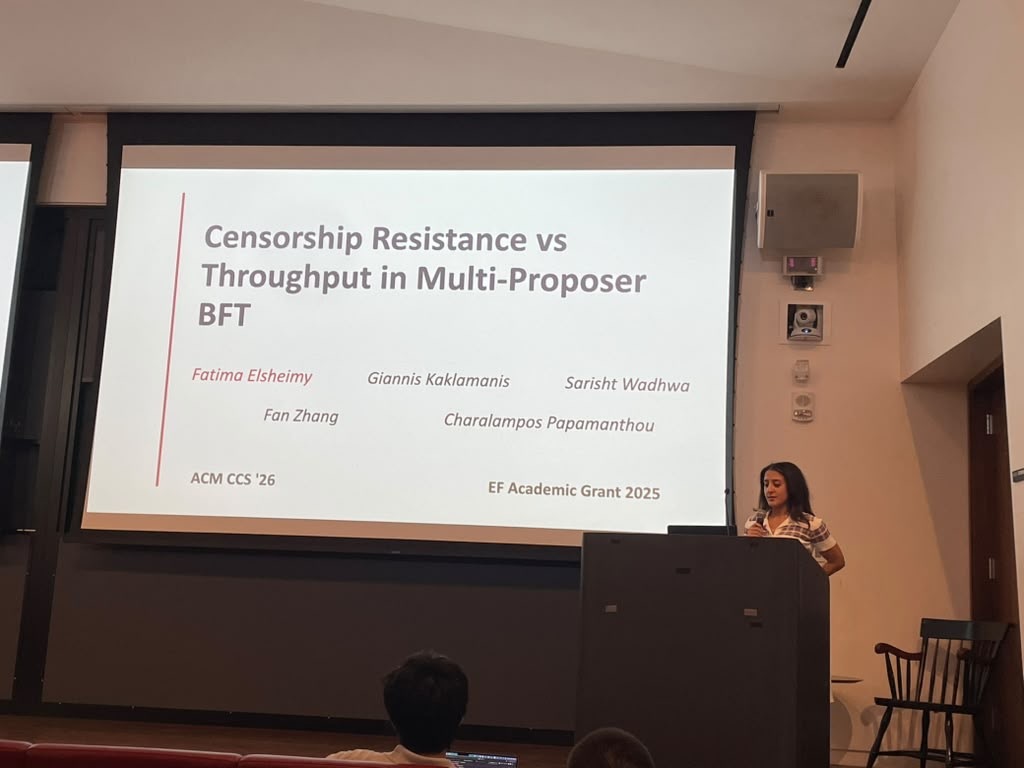
Fatima Elsheimy, PhD student at Yale University, presented her research: Censorship Resistance vs Throughput in Multi-Proposer BFT Protocols.
Transaction censorship is a growing concern. Recent data shows 34.98% of Ethereum builders engage in some form of censorship. Multi-proposer BFT architectures were designed to help, but introduce a fundamental tension: Sending a transaction to more proposers improves censorship resistance but creates duplicates that waste block space and hurt throughput.
Fatima and her co-authors prove this tension is fundamental for deterministic protocols: any protocol guaranteeing constant censorship delay must suffer O(1/f) throughput loss. Conversely, near-optimal throughput forces O(f) censorship delay.
On the positive side, the authors propose transaction-reactive protocols that adapt duplication dynamically — a transaction that keeps getting censored gets assigned to exponentially more proposers. Their best deterministic protocol achieves O(log f) censorship delay at only 2× the optimal throughput cost. Randomized protocols break the deterministic bounds entirely, achieving O(log f) delay with near-optimal throughput.
This work has been accepted to CCS ’26 and was supported by an Ethereum Foundation Academic Grant (2025).
Open Agentic Research
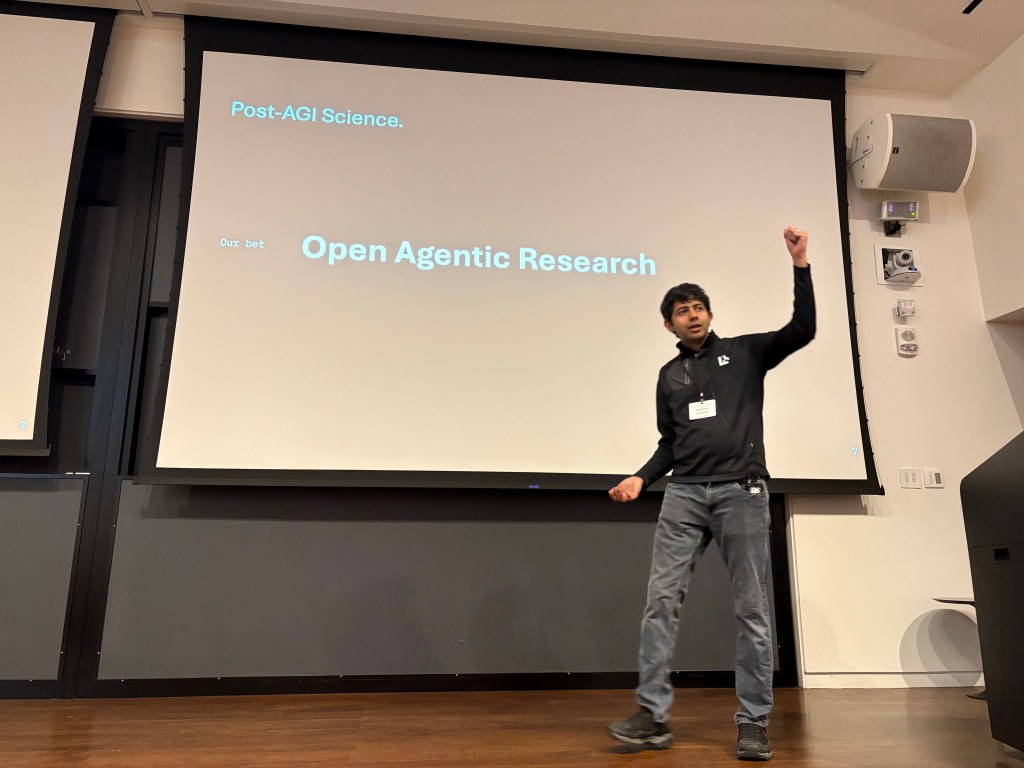
We are approaching a post-AGI world at a staggering rate. As machine intelligence skyrockets, we face critical questions: Who controls it, and who is responsible for the outcomes?
This is what Sreeram Kannan, Founder & CEO at Eigen Labs, spoke about during the IC3 Blockchain Camp. Left unchecked, power naturally centralizes into the hands of a few mega-corporations. Sreeram believes the antidote to this is coordination technologies.
He explained coordination is actually a core part of evolutionary leaps. Historically, massive transitions—from natural selection to the invention of fire—were coordination events. It remains one of the most powerful mechanisms we have to unlock scientific progress.
A recent case study proves this: the Shor-at-home challenge. When Google allegedly obfuscated key optimizations from their March PQC paper via a zk proof, the global research and developer community coordinated independently. In a matter of hours, a new Shor world record was set.
In Sreeram’s view, the goal of crypto is to build open networks that maximize individual agency. Coordination technologies enable us to reach that goal.
Blockchain Anonymous Tokens (BAT)
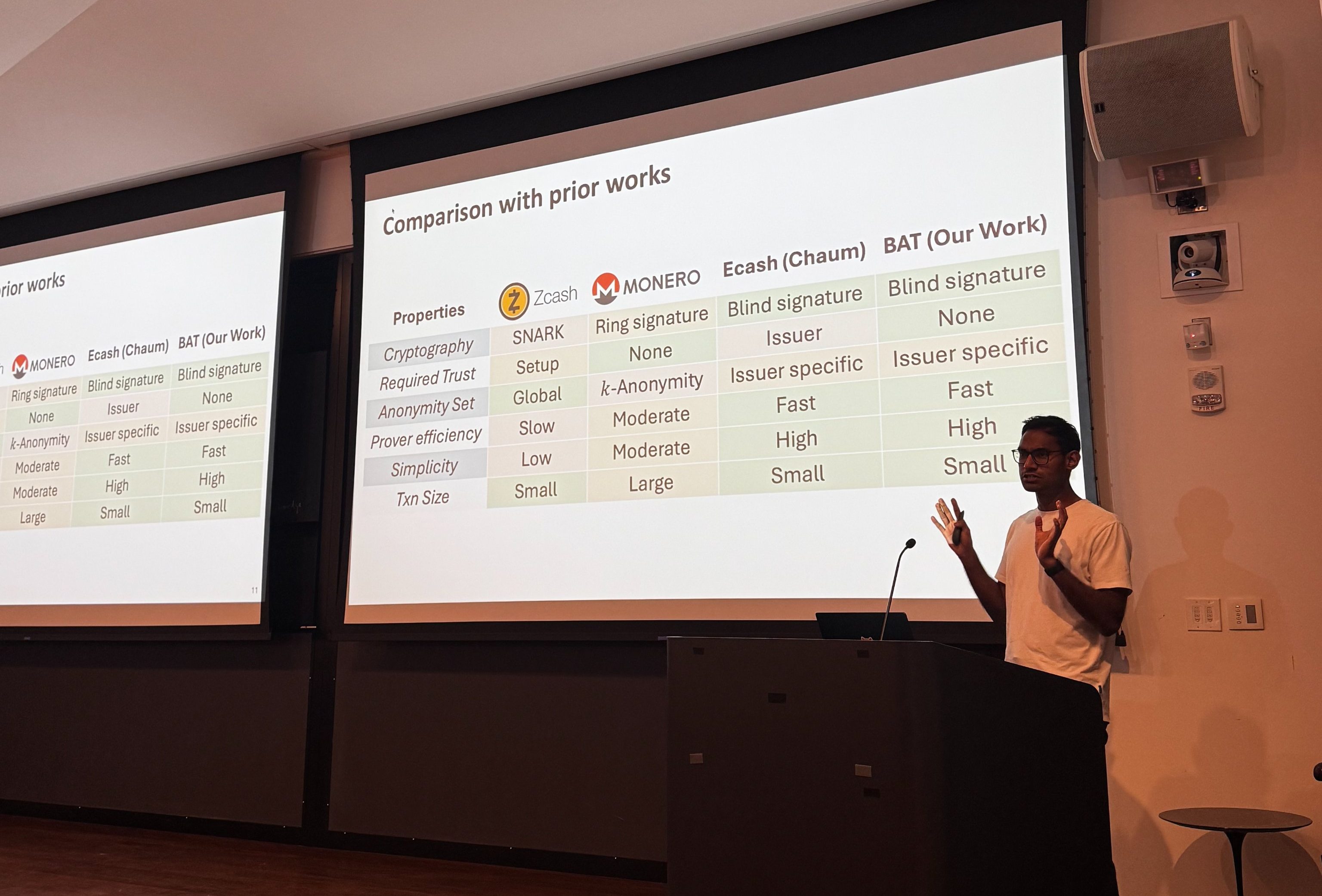
Sourav Das, a researcher at Category Labs, presented research on Blockchain Anonymous Tokens (BAT).
Achieving sender anonymity on transparent networks like Ethereum usually requires heavy cryptographic machinery (i.e., zero-knowledge proofs).
BAT introduces a lightweight paradigm by adapting classic Chaumian tokens (1983) for decentralized, untrusted settings. BAT features compact issuance with 𝒪(1) onchain communication. It avoids expensive onchain ZKP verification entirely, requiring only a single exponentiation during issuance and signature verification for spends.
Security is proven under the one-more CDH assumption in bilinear pairing groups. Sourav and his co-authors prove that concrete evaluation against the closest Zcash baseline demonstrates substantial scalability gains.
BAT tokens are:
• >50x shorter in size
• 9x faster to verify onchain
• 7,000x faster to generate
This results in an efficient, highly scalable cryptographic primitive for sender-anonymous decentralized applications.
Additional Highlights & Recaps
Follow us on X if you’re looking for more highlights from this year’s talks. We’ll see you next year!


 IC3 - The Initiative for Cryptocurrencies and Contracts